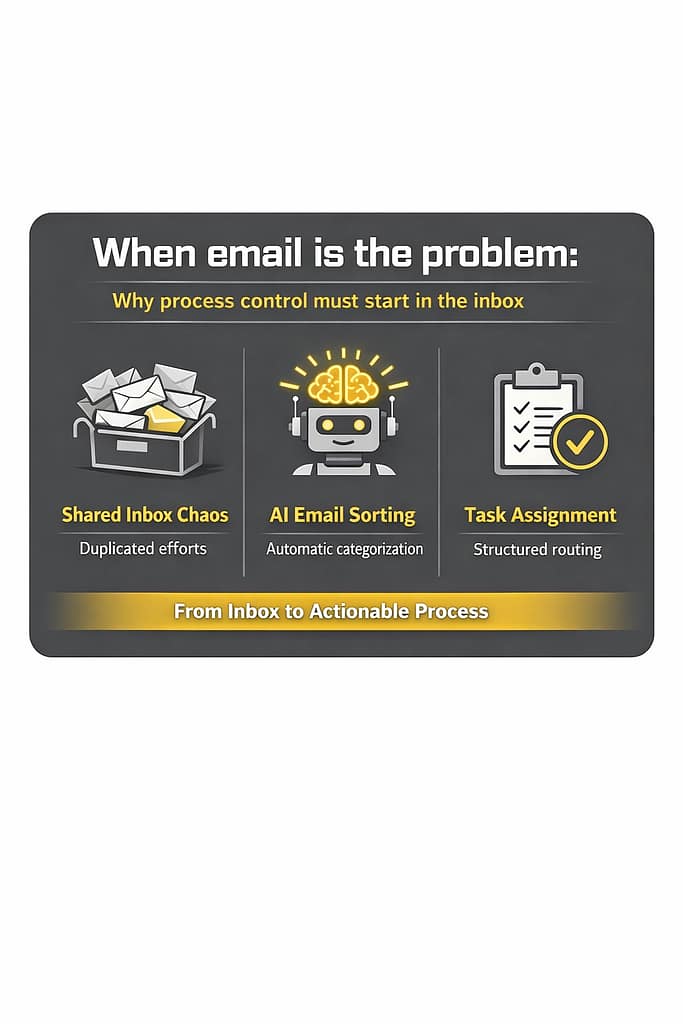
The problem: Email as an unmanaged process trigger
The start of many processes begins with an email communication. A supplier sends an invoice. A customer sends an enquiry. Often these first touchpoints are shared mailboxes that need monitoring, with emails then needing to be assigned to workstreams. This can be a very manual process and may involve subfolders of the mailbox, and sometimes subfolders of subfolders.
An individual monitors the inbox, reads the email, looks at the attachment, categorises the workstream, and assigns the task by dragging the email into a folder. Another user then comes along, sees an unread email, opens it, reads it, looks at the attachment, and actions the task before moving the email into a done folder.
The impact: Duplication and lack of visibility
There is an obvious duplication of effort in this approach. The same email and attachments are reviewed multiple times by different people. At the same time, there is very little visibility, limited task management, and minimal ability to monitor KPIs or response times.
The solution: Introducing control at the inbox
Using a business process management tool to ingest the email, combined with a large language model to categorise its contents and task management to assign and monitor responses, enables a much greater level of control.
Why this matters for automation
Email management and classification is increasingly becoming an important part of many process automation projects. Teams find it highly impactful, both from a day to day time saving perspective and from a customer and supplier service point of view, as well as for internal KPI tracking.